


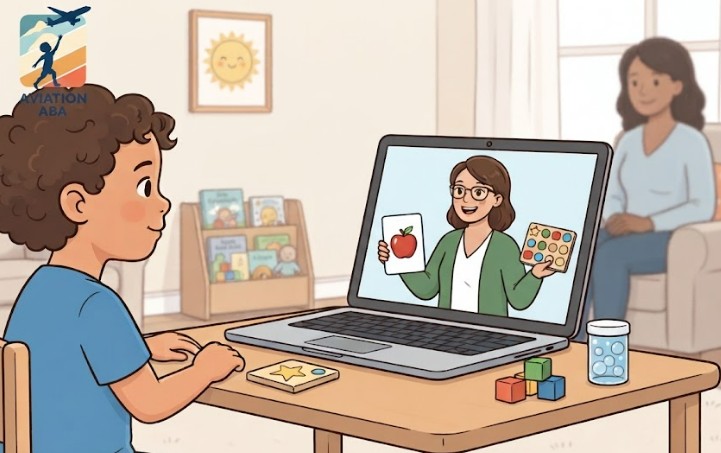
Choosing between in-home ABA and telehealth ABA can feel like one more big decision on an already full parenting plate. Both models can support young children, but they work best in different situations. The right fit usually depends on your child’s learning needs, your family routine, caregiver availability, and how much hands-on support is needed during sessions.
Quick takeaway: In-home ABA is often helpful when a child needs direct support in daily routines, while telehealth ABA can work well for parent coaching, caregiver training, and families who need more flexible access. Many children benefit from a mix of support over time, guided by a Board Certified Behavior Analyst (BCBA).
Key Takeaways
- In-home ABA is best for direct support with daily routines and natural environment teaching.
- Telehealth ABA works well for parent coaching, caregiver training, and flexible access.
- Clinic-based ABA offers structured learning and peer opportunities.
- In-home therapy helps generalize skills into everyday family life.
- Telehealth requires active caregiver involvement and a child who can engage remotely.
- Setting choices can change over time based on your child's progress, goals, and insurance coverage.
Key Differences Between In-Home ABA, Telehealth ABA, and Clinic-Based ABA
Before choosing a setting, it helps to know what each model usually offers. ABA teams often include a BCBA, who designs and supervises the plan, and a Registered Behavior Technician (RBT), who may provide direct therapy. If you’re still learning the difference between these roles, this guide to RBT vs BCBA can help.
| Therapy Model | Often Best For | Possible Limitations |
|---|---|---|
| In-home ABA therapy | Daily routines, family participation, natural environment teaching | Less peer interaction than a clinic setting |
| Telehealth/Virtual ABA | Parent coaching, caregiver training, flexible access | Requires caregiver involvement and a child who can engage remotely |
| Clinic-based ABA | Structured learning, peer opportunities, fewer home distractions | Skills may need extra practice at home |
When In-Home ABA May Be a Better Fit
In-home ABA therapy can be especially helpful when your child’s goals are closely tied to real family routines. For example, sessions may focus on getting dressed, brushing teeth, asking for help, tolerating transitions, or using functional communication during play.
This setting also supports skill generalization, which means helping a child use a skill in everyday places, not just during therapy. Natural Environment Teaching (NET) often fits well at home because learning can happen with familiar toys, snacks, siblings, and routines.
In-home support may also make sense if your child has sensory or body-based behaviors that show up during the day. For example, if you’re noticing patterns like autism toe walking, it may be worth discussing them with your child’s pediatrician and therapy team so everyone understands the full picture.
When Telehealth ABA May Work Well
Telehealth ABA can be a strong fit when the main focus is parent coaching and caregiver training. In this model, the BCBA may guide you through strategies, observe routines virtually, and help you practice responses in the moment.
For many families, this can be helpful because the parent learns how to support the child between sessions, not only during therapy time.
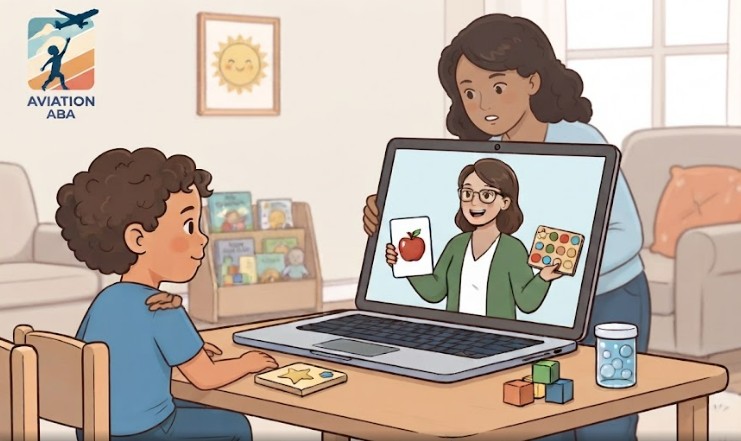
Telehealth may be less helpful if your child needs frequent physical prompting, struggles to attend to a screen, or becomes upset when a caregiver is asked to run most of the session. That does not mean virtual ABA is “bad.” It simply means the model has to match the child and family.
How to Choose the Right ABA Setting for Your Child
A good decision starts with a behavioral assessment and a clear conversation with your BCBA. You may want to ask:
- Does my child need direct, hands-on teaching from an RBT?
- Are our biggest challenges happening during home routines?
- Can I or another caregiver actively participate in telehealth sessions?
- Does my child learn better with fewer distractions or more structure?
- Are social goals or peer practice part of the treatment plan?
- What does insurance cover for each model?
Also think about sensory signs that may affect participation. For example, frequent ear touching, sound sensitivity, or discomfort during routines may be worth tracking. This overview of touching ears autism can help you prepare questions for your provider.
Preparing Your Home for Virtual ABA
If your family tries telehealth ABA, a little preparation can make sessions smoother.
Try to set up:
- A quiet area with limited background noise.
- A charged device with stable internet.
- Favorite toys, snacks, or materials nearby.
- A simple visual schedule if your child uses one.
- A backup activity in case your child needs a short break.
It can also help to choose one routine to work on at a time, such as snack, play, or bedtime preparation. Starting small often feels less overwhelming for both the child and caregiver.
Common Telehealth Challenges and What to Try
If virtual sessions feel hard at first, you are not alone. Common challenges include:
- Your child leaves the area often. Ask the BCBA to shorten tasks, add movement breaks, or use stronger motivation.
- You feel unsure what to do. Request more modeling, simpler instructions, or written steps after sessions.
- Technology interrupts therapy. Keep a backup device or phone number ready when possible.
- The plan feels too hard at home. Tell your provider. ABA goals should fit real family life, not just look good on paper.
Current ABA telehealth discussions often point to access and flexibility as benefits, while also noting that virtual care may not replace every in-person need. There is still limited long-term research comparing children who receive only remote ABA with those who receive only in-person care.
Final Thoughts
In-home ABA and telehealth ABA can both support young children when they are matched carefully to the child’s needs. In-home therapy may be better for direct support in daily routines, while telehealth may be helpful for parent coaching, access, and caregiver-led practice.
A good next step is to talk with your BCBA about your child’s goals, your family’s schedule, and what kind of support feels realistic at home. The best model is not the one that sounds most impressive. It is the one your child and family can actually use with confidence.
References
- Paper: The Efficacy of Using Telehealth to Coach Parents of Children with Autism Spectrum Disorder
- Paper: A Parent-Mediated Telehealth Program for Children with Autism Spectrum Disorder

Sarah McConkie is a Board Certified Behavior Analyst and Clinical Director at Aviation ABA with years of experience supporting children and families through individualized ABA therapy. She has worked across multiple clinical settings, conducting behavioral assessments, developing treatment plans, and supervising therapy teams to help children build important everyday skills. Sarah is passionate about creating supportive, relationship-focused care that helps children feel comfortable, confident, and successful in their daily lives.
