



Naturalistic Developmental Behavioral Interventions, or NDBI, are autism interventions that blend developmental science with Applied Behavior Analysis (ABA) principles in play-based, everyday routines. NDBI is not “the opposite” of ABA. It is best understood as a naturalistic, child-led branch of behavioral intervention, especially common in early autism support.
If you’re comparing therapy options, it helps to understand both the broader benefits of ABA therapy and how NDBI may look different in real life.
Key Takeaways
- NDBI uses ABA principles, but teaching happens through play, routines, shared attention, and child choice.
- Traditional ABA may use more structured methods, such as Discrete Trial Training, while NDBI emphasizes natural learning moments.
- A true NDBI program should show child-led interaction, functional communication goals, data collection, and skill generalization.
- Insurance often covers NDBI under ABA benefits when it is medically necessary and supervised by qualified providers.
- The best choice depends on your child’s developmental profile, communication needs, learning style, and ability to generalize skills.
NDBI vs. Traditional ABA: What’s the Difference?
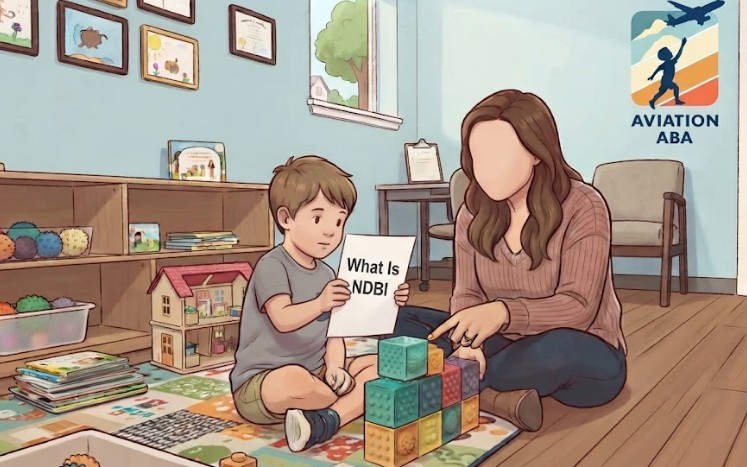
ABA is a broad science of behavior. It includes many teaching methods, from highly structured Discrete Trial Training (DTT) to naturalistic strategies embedded in play and daily routines.
NDBI sits inside that broader behavioral family. According to the widely cited Schreibman et al. 2015 consensus paper, NDBI models share several features: natural settings, child-initiated teaching episodes, developmentally appropriate goals, shared control between child and therapist, and direct use of behavioral learning principles.
A helpful summary from Pathways NDBI describes NDBI as combining developmental approaches with ABA-based teaching, which is the key point parents often miss.
| Feature | Traditional structured ABA | NDBI |
|---|---|---|
| Teaching style | Often adult-led and planned | Child-led within planned routines |
| Setting | Table, clinic, home, school | Play, meals, classroom, playground |
| Common method | DTT, task analysis, reinforcement | Natural reinforcement, modeling, prompting |
| Main goal | Skill acquisition and behavior change | Communication, social engagement, adaptive behavior, generalization |
| Data | Formal trial data or session data | Data tied to routines, interactions, and goals |
What True NDBI Should Look Like in Practice
A clinic may say it uses NDBI, but the session should match the model. Look for these practical signs:
- The therapist follows your child’s interests instead of forcing every activity.
- Goals include functional communication, joint attention, play, imitation, and adaptive behavior.
- Reinforcement is natural. For example, asking for bubbles leads to bubbles, not a random snack.
- Skills are practiced across people, places, and routines.
- The BCBA designs goals and monitors progress.
- RBTs carry out the plan while receiving regular supervision.
- Data is still collected, even if the session looks playful.
If a session is only flashcards, repeated demands, and table work, it may be ABA, but it probably is not strong NDBI.
Insurance Coverage and Billing
Insurance usually does not have a special “NDBI” billing category. In many cases, NDBI is billed under ABA services when it is part of a medically necessary treatment plan supervised by a Board Certified Behavior Analyst.
Coverage depends on your plan, diagnosis, state rules, provider credentials, and authorization requirements. Families using public coverage can start with this guide to whether Medicaid covers ABA. If you have a commercial plan, it may also help to review how Blue Cross Blue Shield handles ABA coverage.
Ask the provider: “Will this be billed as ABA therapy, and how are NDBI goals written into the treatment plan?”
Home and School Examples Over Time
At home, NDBI might begin with a toddler learning to request “open” during snack time. After several weeks, that same goal expands to asking for help with toys, shoes, or a lunchbox. The target is not just saying one word. It is using communication across real situations.
At school, a child may work on joining peer play. The therapist or teacher might coach turn-taking during blocks, then fade prompts as the child begins to copy, comment, or request independently. Over time, the focus shifts from one taught skill to skill generalization.
Research-focused summaries, including Avela Health, describe NDBI as closely related to ABA while emphasizing natural learning contexts.
How Parents Can Choose the Right Approach
Use your child’s profile as the starting point:
- If your child learns best through routines, movement, and play, ask about NDBI.
- If your child needs very specific foundational skills broken into small steps, structured ABA or DTT may help.
- If your child struggles to use skills outside therapy, prioritize generalization.
- If communication is the main concern, look for goals around functional communication, not only compliance.
- If behavior challenges are severe, ask how safety, communication, and replacement skills will be addressed together.
You do not always need to choose one forever. Many strong programs blend structured ABA, Early Intensive Behavioral Intervention, and NDBI based on the child’s needs.
Common Mistakes To Avoid
- Assuming NDBI is not ABA. It usually uses ABA principles in a more naturalistic format.
- Choosing based on labels only. Watch a session and ask how fidelity is measured.
- Ignoring generalization. A skill matters most when your child can use it with different people and settings.
- Forgetting insurance details. Coverage depends on documentation, authorization, and provider qualifications.
References and Further Research
- NCBI – Article on autism
- Kasari, C., Freeman, S., and Paparella, T: Research on joint attention and symbolic play interventions.
- My Parent Advice: Naturalistic teaching.

Sarah McConkie is a Board Certified Behavior Analyst and Clinical Director at Aviation ABA with years of experience supporting children and families through individualized ABA therapy. She has worked across multiple clinical settings, conducting behavioral assessments, developing treatment plans, and supervising therapy teams to help children build important everyday skills. Sarah is passionate about creating supportive, relationship-focused care that helps children feel comfortable, confident, and successful in their daily lives.
