


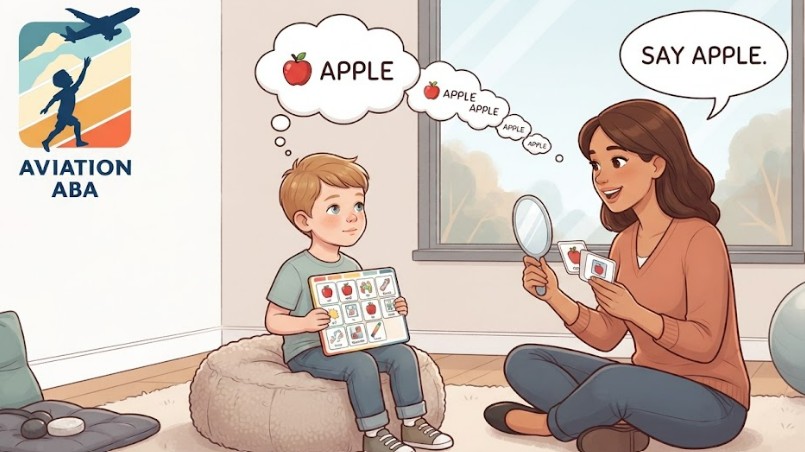
Echolalia means repeating words, sounds, or phrases someone has heard before. In autism, echolalia is often a real part of communication, not “meaningless repetition.” A child may repeat a question, a line from a show, or something you said yesterday because they’re processing language, asking for something, regulating their body, or trying to connect.
If you’re helping siblings understand why a child repeats phrases, it can also help to use simple, respectful language about autism. This guide on explaining autism may be useful for those family conversations.
Key Takeaways
- Echolalia can be immediate, delayed, mitigated, or more sensory-based.
- Many autistic children use echolalia as a step toward flexible, self-generated language.
- The goal is not to “stop” echolalia. The goal is to understand what it may mean and support clearer communication.
- Parents can help by modeling useful phrases, watching context, and responding to the message behind the words.
What is Echolalia in Autism?
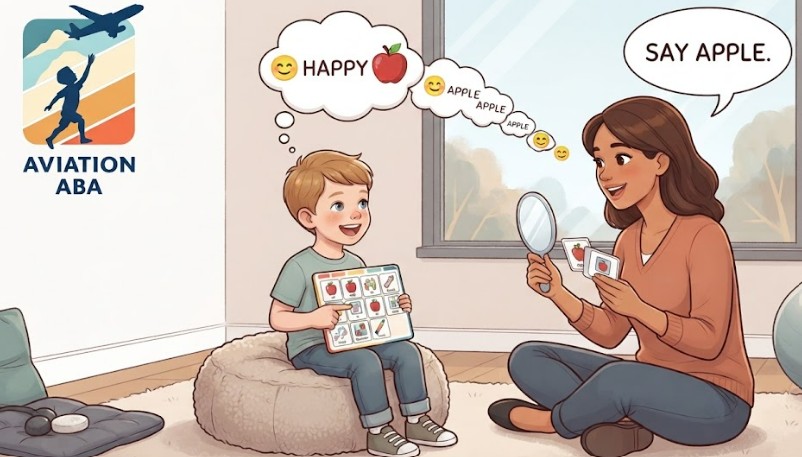
Clinically, echolalia is the repetition of speech heard from another person or source. The Cleveland Clinic describes it as repetition that may happen right away or after a delay.
In plain language, your child may be borrowing language they’ve heard before because it’s the language they have available right now.
That borrowed language can come from:
- Parents, teachers, therapists, or siblings
- TV shows, YouTube videos, songs, or games
- Books, apps, or classroom routines
- Past conversations
Echolalia is common in autistic language development, especially for children who process language in chunks rather than one word at a time. To explore more about how structured language interventions can support these communication pathways, you can review the Autism Spectrum Australia Overview on Echolalia.
Types of Echolalia Parents May Notice
Immediate Echolalia
Immediate echolalia happens right after a child hears something.
Example:
- Parent: “Do you want juice?”
- Child: “Want juice?”
This may mean “yes,” “I’m processing the question,” or “I don’t know how to answer yet.”
Delayed Echolalia
Delayed echolalia happens later, sometimes minutes, days, or even months after the child first heard the phrase. This is often called scripting. A child might repeat a cartoon line during play, at bedtime, or when upset.
Mitigated Echolalia
Mitigated echolalia means the child changes part of a repeated phrase to fit a new situation.
Example:
- Original phrase: “Time to go to school.”
- Child says: “Time to go to park.”
That’s progress. The child is not just repeating. They’re adapting language to communicate a new idea.
Echolalia and Gestalt Language Processing
Some autistic children are gestalt language processors. Instead of learning language one word at a time, they may learn whole phrases first, then gradually break those phrases into smaller, flexible parts.
For these children, echolalia can be a bridge toward more independent language. A speech-language pathologist can help identify whether a child is using gestalt language processing and suggest language modeling that fits the child’s stage. For a detailed breakdown of how speech therapists address gestalt development, you can check out Cleveland Clinic’s Guide on Echolalia and Communication.
Is it Communication or Sensory Repetition?
Sometimes echolalia is functional communication. Sometimes it supports sensory self-regulation. Often, it can be both.
| What you notice | It may mean | What to try |
|---|---|---|
| Child repeats “Want cookie?” near the pantry | Requesting food | Model “I want cookie” |
| Child repeats a movie line while pacing | Regulation or excitement | Stay nearby and observe |
| Child uses a script during a hard transition | Anxiety or protest | Model “I need more time” |
| Child changes part of a phrase | Mitigated echolalia | Expand the phrase gently |
Screen-based scripts are common, so it can help to look at how shows and videos fit into your child’s day. Here’s more on autism and screen time if you’re trying to find a healthy balance.
What Parents Can Do To Support Echolalia
Try these simple, neurodiversity-affirming strategies:
- Respond to the possible meaning. If your child says “Do you want crackers?” while reaching, answer as if they asked for crackers.
- Model from their point of view. Instead of saying “Do you want help?” model “Help me” or “I need help.”
- Keep phrases short and useful. Use language your child can reuse in real life.
- Expand, don’t correct. If they say “Go car,” you can say, “Go in car.”
- Honor regulation. If a script helps your child stay calm, you don’t need to interrupt it unless safety is an issue.
- Track patterns. Notice when scripts happen, who is nearby, and what changed before the repetition started.
If your child has a therapy team, ask how each person supports communication. Understanding the difference between roles like RBT vs BCBA can help you know who to ask about daily strategies, goals, and treatment planning.
Echolalia in Autistic Adults
Echolalia does not always disappear with age. Some autistic adults script quietly, repeat phrases internally, or use familiar language to prepare for conversations. In workplaces, this may show up as rehearsed greetings, repeated phrases in meetings, or quoting familiar lines when stressed.
The respectful response is not to shame the repetition. Give processing time, use clear expectations, and avoid forcing eye contact or rapid answers. A person may be communicating, self-regulating, or both.
Common Mistakes to Avoid
- Treating every repeated phrase as “nonfunctional”
- Asking too many questions instead of modeling language
- Correcting scripts without understanding their purpose
- Removing favorite scripts that help with regulation
- Ignoring modified scripts that show language growth
Final Thought
Echolalia in autism is often meaningful. When you slow down, listen for the purpose, and model language your child can actually use, repeated words can become a doorway into connection, comfort, and communication.
References
- Neely, L., Gerow, S., Rispoli, M., Lang, R., & Pullen, N. (2023). A systematic review of interventions for echolalia in autistic children. Review Journal of Autism and Developmental Disorders. Available at: PubMed Central
- StatPearls Publishing. (2023). Echolalia. National Center for Biotechnology Information (NCBI Bookshelf). Available at: NCBI Bookshelf

Sarah McConkie is a Board Certified Behavior Analyst and Clinical Director at Aviation ABA with years of experience supporting children and families through individualized ABA therapy. She has worked across multiple clinical settings, conducting behavioral assessments, developing treatment plans, and supervising therapy teams to help children build important everyday skills. Sarah is passionate about creating supportive, relationship-focused care that helps children feel comfortable, confident, and successful in their daily lives.
